Tuesday, June 13, 2017

Abacos Islands - TAKE 2!

Seems version 1 went out without any content - So here goes take 2!

The Abacos is a boaters paradise. Located the furthest north in the Bahamas, this 120-mile jewelled necklace of both inhabited and uninhabited islands and cays offers countless mooring spots and a myriad of diversions. 

 
Most people associate the Abacos with Hope Town's iconic Elbow Reef Lighthouse, which is one of only two non-automated lighthouses in the Bahamas.   Built in 1864, this charming lighthouse sits 120 feet above sea level. It's 32,000 candlepower light provides visibility of 17 miles. Climb it's 101 steps for an amazing view - just bring water!

 
For you wooden boat lovers, there's another reason to visit this candy cane striped lighthouse. Come view Scully,  the last 14-foot wooden Abaco dinghy to be built by famed Winer Malone in 2010. These wooden dinghies were the traditional workboat used by Abaconians for fishing, conching, freight, transport and "courting" between islands.  In favorable winds, a sail was used. Alternately, a 10-foot sculling oar was placed in a transom notch. For those who need to know more, look up the Wooden Boat cover story from March-April 1997. These dinghies are still used by locals throughout the Abacos. 
 
There are so many places to stop and explore. These three are all on various cays within a 20 minute boat ride of Little Harbour.  If a sand beach is on your list, be certain to ask before making the trip. Many beaches are coral - and therefore not walkable - or are only accessible at low tide.  Nippers on Guana Cay is a winner - but you will have to walk through the poolside all-music-all-the-time outdoor restaurant. (There's a smaller indoor restaurant if you need some AC & sanity!)
 
We spent a wonderful afternoon with our new found friends the Wells walking and snorkeling. Nine year old Jonathan, number 9 of 9, wanted to see if we could bury him, which Karen proceeded to do. 
 
Steve had a heck of a time pulling him out. Must be time to get back to the gym!
 
Finally we ended up at Man O War Cay. Founded in 1780 by Loyalists who left the Carolinas, the  island's 400 residents are still a close knit group, in fact 70% of the Alburys (easily the island's MOST commmon name) can trace their ancestry to the 1st Alburys who settled here in 1816.  (VERY CLOSE - I'm just saying.) Albury boats are known throughout the Abacos as the most sturdy and well riding means of transport. 

The island is a mere 2-1/2 miles long and about 100 meters wide, with wonderful sandy beaches and a long protective Harbour that will protect you in any wind. There's also an amazing grocery store which will gladly order most anything you could need with 48-hour notice. (Boaters  - you know how diffucult it is to provision in the Bahamas!)

We love the food at the Dock and Dine. The Albury Canvas Shop is famous for its bags. Joe Albury sells his coveted handcrafted items. Andy Albury, of Albury Designs, creates half hulls on spec, as did his daddy, along with wonderful solid furniture.  Other shops offer food and well crafted items from M-O-W-ers,  as well as other Bahamians. 

With ferry transport, homes to rent and a fantastic harbor, M-O-W should be on everyone's list. But bring your own liquor.  This proudly conservative, god fearing island does not sell liquor. Although a glass of wine or beer can be bought with a meal, you'll be so relaxed, you won't miss it - promise! 

Monday, May 22, 2017

Harbour Island, Eleuthera - Oh the Colors!

 
Every Bahamanian Island settlement has its own personality. On Harbour Island you're immediatly struck by the calming beauty of pastel colored wooden cottages that overflow with lush flowering tropical foliage. 
 
Every winding street has a story to tell. Whether it's St John's Anglican Church, established in 1767 and the oldest on the island, or one of its British Loyalist clapboard homes.  
 
Colorful murals celebrate, decorate or draw you inside.  Feel free to explore. Residents are happy to chat, laugh and tell you stories, even if you're "only looking". Well, okay, you might find boxes made of shells  or colorfully embroidered rayan for your granddaughters.  
 
When you're done, indulge in some time at the pink sand beaches or by the pool with a glass of iced tea and maybe a sketch pad that has been sitting idle for too long. 

The restaurants are many and all wonderful. Sip-Sip is a colorful lunchtime favorite, on top of the eastern shore cliffs, looking down where wild horses run on endless pristine pink sand beaches.  (You WANT the lobster quesadilla!) That's Harbour Island. 

Thursday, May 18, 2017

Across Devil's Backbone to Harbour Island

 
After a couple of peaceful days anchoring in the Berry Islands, we're off to Eleuthera.
 
 Like most anticipating this tricky crossing, we stop at Spanish Wells to pick up a guide to assist us in navigating the Devil's Backbone coral heads between the Berry and Eleuthera islands. The guide ties his much smaller boat onto your stern, takes over as captain and he speeds away maneuvering the unmarked coral. One false turn and you better be ready to swim. There's no Tow Boat US or coastguard here. We've relied  on Bandit to guide us since our first crossing in 2006 - AND......
 
 
to supply us with Stone Crab claws -  deliciously sweet, larger than you'll ever see and as fresh as they come. When we're really lucky, "Mrs Bandit" sends along coconut bread. 

 
 Spanish Wells itself is worth a stop. It's first settlers were of Scottish descent, unexpectedly landing here when shipwrecked crossing the Devil's Backbone on their way from the Bahamas to Eleuthera in 1647. (They should have called Bandit!) They were followed in the mid-1700s by British Loyalists escaping America. (Yup - you read that right.) 

Today Spanish Wells is the primary settlement on St George's Cay with a population just under 2,000. They remain primarily of British descent, Caucasian with a very specific accent and dialect, all of which makes the island and its inhabitants unique within the Bahamas. The majority of its youth leave the island for a college education with over 95% returning to live here. Commercial fishing, lobster and stone crabs are their primary industries. The settlement was dry until about 5 years ago, when they opened up to tourism.  So we suggest you skip the Stone Crabs on South Beach and put Spanish Wells on your list. You can always fly to Eleuthera and ask Bandit to bring you across - who knows, maybe he'll offer you Stone Crabs and coconut bread!
 

Sunday, May 14, 2017

Great Harbour Cay


The northern reaches of the Berry Islands are a delight. Very few of the islands are developed. Great Harbour Cay is one of the larger islands, with a perfect marina  - excellent in a storm, has everything you need, but not so sophisticated that you forget your in the Bahamas.  

 
Three times a month, the mail boat arrives from Nassau. Pallets move all matter of provisions to a variety of transport, as cars and vans crowd the pier awaiting their turn.  The local "all age" school boasts coat of arms, pictured here. Everyone is feeling festive!

 
We pedal over to the islands east side to the Beach Club restaurant.  Positioned along a beautifully arching ribbon of white sand and 80-degree turquoise water, it's well worth the effort. The fish is fresh, the freshly made plump burgers delicious and the Art Shack boasts local artisans creations.  Patrons drive, pedal, jet ski and wade in from anchored boats. Open for breakfast and lunch, life is truly a beach here.  

 
Our other find was Carriearl Boutique Hotel and Restaurant. Angie and her husband came here from the U.K. before the economic crash and then decided to stay on. The surroundings, company and food was so superbly spot on, we came back for a second evening. 

Great Harbour can be the perfect spot for those who want beautiful surroundings, a few modern conveniences and a true Bahamian experience.  We'll be back, so just let us know.   

Saturday, May 13, 2017

We are on the Water!


May 7, we departed Useppa on Blue Chip, which will essentially be "home" for the next six weeks.  

 
First stop is Little Shark River, part of the Everglades 10,000 Islands National Park. The wildlife and birds are incredible here.  Needless to say, you are miles from man-made light, there's no internet and hope that your GPS is working or you could find yourself amongst these mangrove islands indefinitely! 
 
 
Birds on stakes mark the way as we cruise from west to east through the northern Keys shallow waters near Islemorada. 

Next stop Miami and on to the Bahamas. 

Monday, May 8, 2017

The Journey Continues!

We can't even begin to explain where we've been these last 9 months. Steve was teaching this past Fall at HBS. Karen was at art school in Sarasota, spending weekends with Steve on Useppa island in southwest Florida. Beyond wonderful friends, it's sailing for Steve and butterfly gardening for Karen.  

The winged guests were numerous. As we prepared to depart Useppa for a month of boating on Blue Chip, it is the black Polydamas  butterflies who dominate. 
 

Dozens can be found flitting around the garden  mating and laying their eggs.

 
Their caterpillars of all sizes munch away on our Dutcman's Pipevines, with its plate sized purple with yellow splotched flowers.  
 
This week we had the added delight of hundreds of hummingbirds descending on Useppa, particularly in the butterfly garden where there is an abundance of nectar plants. They've  been playing tag with the black Polydamas butterflies. The green feathered dimunituve birds easily blend in with their favorite firebush. 
 
The exceptional number of  enchanting hummingbirds is the result of a "fallout" having been buffeted by recent storms while on their migratory pathway North for the summer. We welcome them with plants they absolutely need to feed on in order to finish their journey - as we also prepare for our journey North. 

Tuesday, August 2, 2016

Biking near Venice

We love to bike when on vacation and our friends Jim and Debbie, who were with us in Venice, are serious bikers - so what's more natural than to put together a 4-day biking trip of the nearby mainland? It's an opportunity to see the countryside and work off some of those calories we've been accumulating.

The countryside in this area is relatively flat. The River Po, its tributaries and canals mean that it is ideal for agriculture. Many would say this area is Italy's breadbasket. We certainly saw acres of corn, grain, pear and other fruit trees 
 ....and of course sunflowers. 
Stopping each evening in various small historical towns along the way gave a different dimension to our trip to date. The classic architecture of Mantova's town square was elegantly statuesque. 
Of course there are lunch stops along the way. Although often an Osteria in a small village, the owners of this riverside gathering spot went to their home to make us local specialties - pumpkin filled ravioli like pasta, fresh ricotta and greens tortellini, two kinds of sweet orange melon and prosciutto crudo that will spoil you forever. 
Ferrara is one of the few castles in Europe surrounded by water, the moat filled by a series of underground pipes from the nearby Vilano River Po. It's amazingly well preserved, regularly hosting art and music events. 
The entrance to Ferrera's charming town square entices with playful umbrellas. Note, August is Italy's holiday month, so these tables will begin filling up around 10 with children and adults of all ages and stay full until the wee hours, well past our "early" American bedtime. 
Chioggia and the charming 100 year old Hotel Grand Italia has brought us full circle. The vaporetto stop next to the water will bring you to the beaches of Lido or the northern shores of Venice, with its unmistakable cluster of terra cotta roofs, readily visible as they curve toward the horizon. Just beyond are the outline of the alps. 
It's been four interesting, but quite warm and tiring days of bike riding. We're questioning how many calories we actually worked off. Ciclismo Classico was as good at finding eateries as they were planning our itinerary! We thank Debby & Jim for letting us tag along. This time tomorrow we'll be back in Boston on our way to a James Taylor concert at Fenway, wondering where the time went!


Monday, August 1, 2016

Murano - Burano - Venice

I
Venice is lovely anytime of year, but please don't forget the nearby islands. Buying a daily or weekly pass provides unlimited access to Venice and almost anything reachable by vaporetto - or water-bus. 
Murano is a 30 minute trip from the northern shore of Venuce. The center of town is marked with this unmistakeable blue glass sculpture. There is the glass factory museum and many shops. For the very fortunate, look for an opportunity to visit a working glass artists studio. 
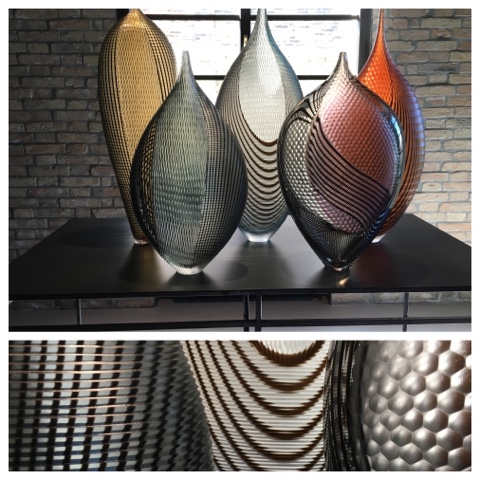
Lino Tagliapietra was born and raised on Murano. For some years he has lived in Seattle, combining traditional techniques with avant guard approaches to art glass. He has galleries in London and the US, but it is his new gallery on Murano, run by his son Silvano, that provides an intimate view of his work. Lino is considered by most to be the best living glass blower of our time. 
These are some of his newer vessels. Pieces are usually blown (hot work)in the United States, but often the fine engraving (cold work) which gives these pieces their uniquely fine detail, are sent back to Murano and its artisans. 
Lino has tremendous variety in his work. This 6 foot panel, remiscent of a Gustav Klimt piece actually has tremendous depth. If your lucky, there is also a personal upstairs gallery that is a mini retrospective. 

Amy West is a Midwest born and raised artist who came to Murano some years ago. Her work also varies from finely etched vessels to translucent water and cloud colored gem like beads that are strung together into jewelry that seems to almost float around the neck. I'm particularly attracted to her opaque River stones, which are modeled after the variety found along specific rivers in the region. Her work is found in galleries in London, New York and Boston. 
And then there is Burano. Traditionally known for lace making, you can still find lovely fabrics here. But it is the boldly colored houses that can be seen reflected in the canal water that will make your jaw drop! 
It's said the origin of these brightly colored buildings was to guarantee finding one's way home even in the deepest fog. Today the weave a maze you will be happy to get lost in. 
Back in Venice, there is always something new to see. The Bienalle Architettura Venice is currently happening. The 2016 theme is 
"Reporting From the Front," which is an investigation into the role of architects in the battle to improve the living conditions for people all over the world. The theme aims to focus on architecture which works within the constraints presented by a lack of resources, and those designs which subvert the status quo to produce architecture for the common good - no matter how small the success." 
The results are amazing. Besides the country specific Pavillion installations, there is the multi country Arsenale, which I often like better. Besides these more abstract ideas, the artists also referenced yurt villages in Mongolia, massive refugee solutions and Kumba Mella in India which is in its own way a "city" when 100 million regularly gather for a 55 day pilgrimage celebration. And yes, MIT was also represented here. 

The islands of Venice and its surrounds. Simply amazing! We were so fortunate to have our 5 precious days here. 


The Merchant of Venice - The Idea that Launched our Trip

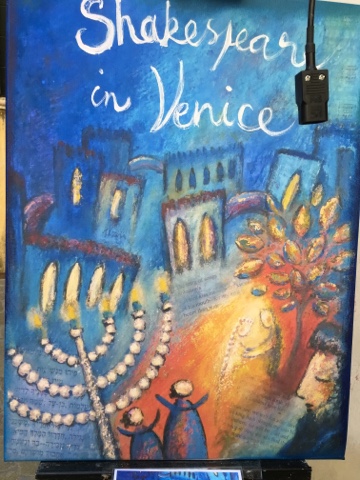
Last October Karen was visiting Venice and heard that in celebration of the 500th anniversary of the Venice ghetto and the 400th anniversary of Shakespeare's birth, the Merchant of Venice would be performed outdoors at the Venice Ghetto in English. Besides a number of related activities, Ruth Bader Ginsberg would preside at a mock trial of Shylock, Antonio and Portia. Certainly a very tempting proposition.  Then we discovered MIT's humanities department was intimately involved along with PBS, the BBC, Columbia and Ca’ Foscari University. How could we miss this?
Landing in Venice is in itself a special experience. Flying over the Adriatic Sea in preparation for landing on the last piece of the mainland that will link you to this magical city of islands, you approach looking down on farmland that turns into lacy appearing lagoons and ultimately the islands that comprise Venice. 
We stayed at Ca' Sagredo along the Grand Canal in the Cannaregio area, close to the Ghetto Nuevo in the northwest part of Venice and a good 15 minute walk from the crowds of St. Mark's square. What a magnificent hotel and convenient venue just far enough away from the stifling crowds. 
The performance was an insightful and unique interpretation by Ca’ Foscari University. We did our homework beforehand both reading the text and watching the Al Pacine, Jeremy Irons version on DVD - highly recommended. The story is often thought to reflect negatively on people of Jewish heritage. However, particularly seen through the lens of today's xenophobic events, it begs the question if Shakespeare was in fact thinking about how those that are thought of as "different" are perceived and unfairly treated. 
Steve had his moment with Supreme Court Justice Ginsberg. They compared notes on her time at Harvard Law School as one of the first female students, along with  Steve's cousin. 
The trial with the US Ambassadir to Italy, along with three other Italian and US dignitaries or academics as judges, three as prosecutors and two as commentariats had everyone on the edge of their seat.  We won't tell you the judges' decision, you can get that from bthe New York Times, but we will say the event was as memorable as the play. 

A tour of three of the original remaining synagogues still used today was incredibly interesting, along with explanations of the ghetto's evolution. Jewish people found Venice and the surrounding area as a relatively safe haven from persecution as early as the 13th century. The Ghetto, which means foundary, was an area where scrap ores had been kept. At the time, the then powerful city of Venice was encouraging immigration and welcomed the Jewish people. In the 16th century, the Ghetto was a mutually agreed upon area between the Jewish community and the Italin government. It created a safe haven for the much persecuted Jewish people from the rest of Europe. Jewish people were restricted in their profession so as not to compete with Italians. They were locked in behind the Ghetto's gates after nightfall, which served both parties. It's  doors were permanently opened by Napolean in 1747, when there were as many as 5,000 living here. Today there are less than 400 Venetsin Jews. 
Our group of six MIT event sponsors enjoyed a private tour of the Guggenheim, which even Steve found interesting. Peggy Guggenheim was an orphan of the Titanic, Jewish and a woman ahead of her time who marched to the  tune of a different drummer. She famously purchased more than one art piece per day to protect the art  from possible destruction by the Nazis. 
The Dodge's Apartment Palazzo Ducale's fantastic exhibit "Venice the Jews and Europe 1516 to 2016". The content, technology and insight was superb. 
In all we had a fantastic time and met wonderful people. We learned a tremendous amount and are grateful to all those who conceived and executed this anniversary event. We would do it again in a second!