Showing posts with label Venice. Show all posts

Tuesday, August 2, 2016

Biking near Venice

We love to bike when on vacation and our friends Jim and Debbie, who were with us in Venice, are serious bikers - so what's more natural than to put together a 4-day biking trip of the nearby mainland? It's an opportunity to see the countryside and work off some of those calories we've been accumulating.

The countryside in this area is relatively flat. The River Po, its tributaries and canals mean that it is ideal for agriculture. Many would say this area is Italy's breadbasket. We certainly saw acres of corn, grain, pear and other fruit trees 
 ....and of course sunflowers. 
Stopping each evening in various small historical towns along the way gave a different dimension to our trip to date. The classic architecture of Mantova's town square was elegantly statuesque. 
Of course there are lunch stops along the way. Although often an Osteria in a small village, the owners of this riverside gathering spot went to their home to make us local specialties - pumpkin filled ravioli like pasta, fresh ricotta and greens tortellini, two kinds of sweet orange melon and prosciutto crudo that will spoil you forever. 
Ferrara is one of the few castles in Europe surrounded by water, the moat filled by a series of underground pipes from the nearby Vilano River Po. It's amazingly well preserved, regularly hosting art and music events. 
The entrance to Ferrera's charming town square entices with playful umbrellas. Note, August is Italy's holiday month, so these tables will begin filling up around 10 with children and adults of all ages and stay full until the wee hours, well past our "early" American bedtime. 
Chioggia and the charming 100 year old Hotel Grand Italia has brought us full circle. The vaporetto stop next to the water will bring you to the beaches of Lido or the northern shores of Venice, with its unmistakable cluster of terra cotta roofs, readily visible as they curve toward the horizon. Just beyond are the outline of the alps. 
It's been four interesting, but quite warm and tiring days of bike riding. We're questioning how many calories we actually worked off. Ciclismo Classico was as good at finding eateries as they were planning our itinerary! We thank Debby & Jim for letting us tag along. This time tomorrow we'll be back in Boston on our way to a James Taylor concert at Fenway, wondering where the time went!


Monday, August 1, 2016

Murano - Burano - Venice

I
Venice is lovely anytime of year, but please don't forget the nearby islands. Buying a daily or weekly pass provides unlimited access to Venice and almost anything reachable by vaporetto - or water-bus. 
Murano is a 30 minute trip from the northern shore of Venuce. The center of town is marked with this unmistakeable blue glass sculpture. There is the glass factory museum and many shops. For the very fortunate, look for an opportunity to visit a working glass artists studio. 
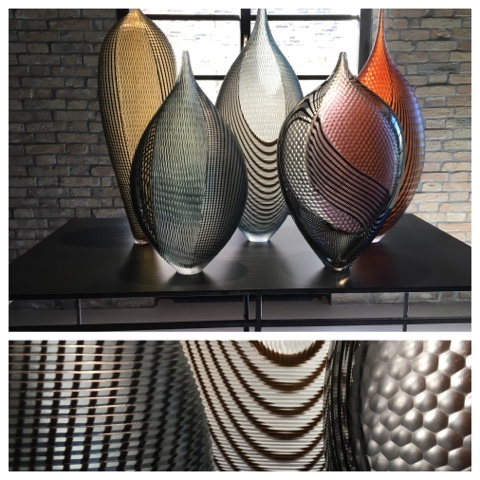
Lino Tagliapietra was born and raised on Murano. For some years he has lived in Seattle, combining traditional techniques with avant guard approaches to art glass. He has galleries in London and the US, but it is his new gallery on Murano, run by his son Silvano, that provides an intimate view of his work. Lino is considered by most to be the best living glass blower of our time. 
These are some of his newer vessels. Pieces are usually blown (hot work)in the United States, but often the fine engraving (cold work) which gives these pieces their uniquely fine detail, are sent back to Murano and its artisans. 
Lino has tremendous variety in his work. This 6 foot panel, remiscent of a Gustav Klimt piece actually has tremendous depth. If your lucky, there is also a personal upstairs gallery that is a mini retrospective. 

Amy West is a Midwest born and raised artist who came to Murano some years ago. Her work also varies from finely etched vessels to translucent water and cloud colored gem like beads that are strung together into jewelry that seems to almost float around the neck. I'm particularly attracted to her opaque River stones, which are modeled after the variety found along specific rivers in the region. Her work is found in galleries in London, New York and Boston. 
And then there is Burano. Traditionally known for lace making, you can still find lovely fabrics here. But it is the boldly colored houses that can be seen reflected in the canal water that will make your jaw drop! 
It's said the origin of these brightly colored buildings was to guarantee finding one's way home even in the deepest fog. Today the weave a maze you will be happy to get lost in. 
Back in Venice, there is always something new to see. The Bienalle Architettura Venice is currently happening. The 2016 theme is 
"Reporting From the Front," which is an investigation into the role of architects in the battle to improve the living conditions for people all over the world. The theme aims to focus on architecture which works within the constraints presented by a lack of resources, and those designs which subvert the status quo to produce architecture for the common good - no matter how small the success." 
The results are amazing. Besides the country specific Pavillion installations, there is the multi country Arsenale, which I often like better. Besides these more abstract ideas, the artists also referenced yurt villages in Mongolia, massive refugee solutions and Kumba Mella in India which is in its own way a "city" when 100 million regularly gather for a 55 day pilgrimage celebration. And yes, MIT was also represented here. 

The islands of Venice and its surrounds. Simply amazing! We were so fortunate to have our 5 precious days here. 


The Merchant of Venice - The Idea that Launched our Trip

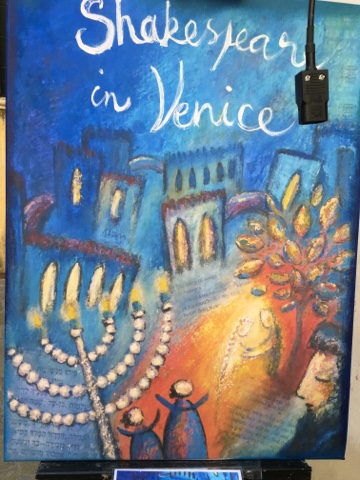
Last October Karen was visiting Venice and heard that in celebration of the 500th anniversary of the Venice ghetto and the 400th anniversary of Shakespeare's birth, the Merchant of Venice would be performed outdoors at the Venice Ghetto in English. Besides a number of related activities, Ruth Bader Ginsberg would preside at a mock trial of Shylock, Antonio and Portia. Certainly a very tempting proposition.  Then we discovered MIT's humanities department was intimately involved along with PBS, the BBC, Columbia and Ca’ Foscari University. How could we miss this?
Landing in Venice is in itself a special experience. Flying over the Adriatic Sea in preparation for landing on the last piece of the mainland that will link you to this magical city of islands, you approach looking down on farmland that turns into lacy appearing lagoons and ultimately the islands that comprise Venice. 
We stayed at Ca' Sagredo along the Grand Canal in the Cannaregio area, close to the Ghetto Nuevo in the northwest part of Venice and a good 15 minute walk from the crowds of St. Mark's square. What a magnificent hotel and convenient venue just far enough away from the stifling crowds. 
The performance was an insightful and unique interpretation by Ca’ Foscari University. We did our homework beforehand both reading the text and watching the Al Pacine, Jeremy Irons version on DVD - highly recommended. The story is often thought to reflect negatively on people of Jewish heritage. However, particularly seen through the lens of today's xenophobic events, it begs the question if Shakespeare was in fact thinking about how those that are thought of as "different" are perceived and unfairly treated. 
Steve had his moment with Supreme Court Justice Ginsberg. They compared notes on her time at Harvard Law School as one of the first female students, along with  Steve's cousin. 
The trial with the US Ambassadir to Italy, along with three other Italian and US dignitaries or academics as judges, three as prosecutors and two as commentariats had everyone on the edge of their seat.  We won't tell you the judges' decision, you can get that from bthe New York Times, but we will say the event was as memorable as the play. 

A tour of three of the original remaining synagogues still used today was incredibly interesting, along with explanations of the ghetto's evolution. Jewish people found Venice and the surrounding area as a relatively safe haven from persecution as early as the 13th century. The Ghetto, which means foundary, was an area where scrap ores had been kept. At the time, the then powerful city of Venice was encouraging immigration and welcomed the Jewish people. In the 16th century, the Ghetto was a mutually agreed upon area between the Jewish community and the Italin government. It created a safe haven for the much persecuted Jewish people from the rest of Europe. Jewish people were restricted in their profession so as not to compete with Italians. They were locked in behind the Ghetto's gates after nightfall, which served both parties. It's  doors were permanently opened by Napolean in 1747, when there were as many as 5,000 living here. Today there are less than 400 Venetsin Jews. 
Our group of six MIT event sponsors enjoyed a private tour of the Guggenheim, which even Steve found interesting. Peggy Guggenheim was an orphan of the Titanic, Jewish and a woman ahead of her time who marched to the  tune of a different drummer. She famously purchased more than one art piece per day to protect the art  from possible destruction by the Nazis. 
The Dodge's Apartment Palazzo Ducale's fantastic exhibit "Venice the Jews and Europe 1516 to 2016". The content, technology and insight was superb. 
In all we had a fantastic time and met wonderful people. We learned a tremendous amount and are grateful to all those who conceived and executed this anniversary event. We would do it again in a second!


Tuesday, October 13, 2015

Rome - Molto Bene


Rome - where to begin? Fortunately Cinzia, a friend who recently moved back to Rome and who also has a background in architecture, came to my rescue. There were countless kilometers of walking, fortified with latte macchiato and high octane vegetable juices and you too can conquer much of Rome in a minimal amount of time. 
         
The Colosseum can't help but impress. Since pedestrian streets mean that  traffic is no longer an issue, you can wander around, envisioning the power the Flavian Ampitheatre had on its early guests in 80AD, when inaugurated by Emperor Titus. 100 days of celebratory games and the destruction of thousands of wild beasts set the tone for the Coliseum, until slaughter-as-sport was outlawed in 523AD. 
  
                        
A short distance down the street is Fora Romano - a series of forums, each built by successive emperors leaving their mark. The Forum of Nerva still boasts two Corinthian columns and a frieze depicting the myth of Arachne. 
                       
Layers of Roman life are revealed, with brick filling in for missing marble to show how columns were pieced together. Column decoration - Ionic, Doric or Corinthian - help to indicate age. They ages are all older than you can ever imagine - think Augustus completion in 42BC, Julius Cesar, Claudius and Nero, who watch Rome burn in 64AD, plus Titus and others. 
       
A panorama reaches across centuries. It includes  112AD Colona Traina, (Column of Trajan), the domed baroque 1685 Santissimo Nome Di Maria al Foro Traiano Church, (Church of the Holy Name), with a peek to the left of Altare Della Patria, (Altar of the Fatherland), inaugurated in 1911 to celebrate Victor Emanuelle, the first king of a unified Italy and is known for including the monument which contains the Tomb of the Unknown Soldier, built after WWI. 
                                    
The narrow winding streets of the Jewish quarter, is one of the most ancient and truly Roman areas of the city. It is known to be the oldest Jewish community in Europe. And one of the oldest continuous Jewish settlements in the world. Near the Tibris River, it's a place to wander, escape the crowds and eat amazing food. 
                                  
The silence that can be found inside small neighborhood churches create an instant sanctuary. Each has its own character, yet keeping them separate in your mind can be a challenge. 


Piazza Navona is one of Rome's loveliest pedestrian squares. Bernini designed the central Fountain of the Four Rivers. The square is lined with palaces, and today, cafes. 
                       
The Parthenon - a marvel in 125AD - still awes hundreds of years later. It's airy interior and perfect proportion remain a wonder of the world. The bold 27-foot hole at the top of the dome's center provides light and structural support. The entire structure's design seems to hover, weightless.  
Cross the Tibris and to Vatican City's Saint Peter's Square and Basillica. Covering 120 acres, it is a theocracy to just over 550 citizens, headed by the pope. What may be most incredible, is it's extremely close proximity to busy streets filled with shops, cafes and homes. Imagine the White House in the middle of Boston's Beacon Street or New York City's West village. 
        
Michelangelo, Gian Lorenzo Bernini and Donata Bramante were the most renowned architects of St Peter's Basillica. There is something about the symmetry that brings a sense of peace and containment. 
                                   
Before leaving Rome, make sure to find time to wander the Villa Borghese park. The southern views over the city can't be beat. Wander the gardens, rent a bicycle or visit it's wonderful museums. The Bourghese Gallery has a number of famous works and might require calling ahead to reserve tickets. The Galleria Nazionalle d'Arte Moderna has a collection of Italian focused and European art from the late 1800's until today. 
           
Setting the stage to the d'Arte Nationalle, the entrance combines cracked Venetian glass, topped with plaster cast of renowned female Roman statuary - juxtaposing the old with the new. 
                       
The art collection is broad - filled with names you know and others that you wan to know better. Originally built as a summer residence to the Borghese family, as a retreat from their Roman residence, this heart shaped garden continues to act as a retreat to many - residents and guests alike - so visit!

This overciew is about half of what was visited in less than three days. There's certianly so much more to experience. And I didn't even mention the food, the markets and the sidewalk cafes! Whats's the secret? A good friend whose keeps you from getting lost and contagious enthusiasm motivates you to wander down one more street.  Thank you Cinzia!


Monday, October 12, 2015

Venice - Arts excursions


The Venice Bienalle is a much lauded international event that originated in 1895 to promote tourism. These days, tourism is certainly not an issue, but the Bienalle is certainly an important reason to travel to Venice between May and Novmber.  MIT has represented the US three times. This year, Paul Ha, the MIT contemporary art LIST museum director was the American Pavillion curator. H selected Joan Jonas, a pioneer of video and performance art and one time MIT instructor, who at 79, created what was easily one of the best and most memorable exhibits at this year's Bienalle, which was themed All the World's Future. 
                       
    
Jonas installation certainly reflects the Bienalle theme and brings you through four multimedia rooms reflecting fragility, loss, regeneration and conservation. It is an emotional, multi layered experience. Images of our delicate environment are layered with fragility of age seen in conjunction with video of youth interspersed with Joan Jonas in the winter of her life. It is a visually charged, highly personal yet universal conversation, where each viewer is free to take away what speaks to them. 


Although there were many notable pavilions, the Japanese "Key in Hand" by Berlin artist Chiharu Shiota had a sense of beauty and emotionality difficult to put into words. The exhibit took two months to install with its 15-thousand keys. Endless red string acts as a linear origami and along with other familiar daily life object, brings the viewer through a multilayered dream-like sense of the known and the unknown - life and death - light and darkeness and the possibility of spiritual brightness. According to the curator, "this is a light that is inherent not only in tremendous anxiety that plagues Japanese people but in the precarious state of things all over the world."

Other notable exhibits were Australia - voted most popular at the May opening - Switzerland, Denmark and  Holland. Look them up and take a tour. 

                
 The Peggy Gugegenheim Collection is not to be missed. Founded in 1951, it is clearly a personal act of love and considered one of the most important museums in Italy for European and American 20th century art. Picasso, Leger, Pollock (Peggy was his first financial benefactor), Max Ernst her one time husband - the list is a whose who of early 20th century art.
               
The experience is also personal. Note this Calder bedframe, made for and used by Peggy Guggenheim in this room. A unique woman for any age, she was born in 1898 to a wealthy New York family. Her father went down in the Titanic and she was the niece of Soloman R. Guggenheim who would establish the famed NY Guggenheim. Peggy made Venice her home. She evolved, traded and created this collection between 1938 and 1946. Exhibited in her home on the Grand Canal, it is one of Venice's most visited attractions - so plan on getting there early or do as we did and find a group that obtains unique access.  To find out more about this unque woman, look up Anton Gil, who was is her official biographer. 
                   
The Palzzo Grassi is a physical space worth experiencing as it strips an  ancient structure to its bare essence with exposed brick and wooden beams. Director Marco Ferraris introduces us to the current exhibit, Slip of the Tounge, curated by Danish-Vietnamese Dan Ho, who was the contributor of the Danish Biennale exhibit. 
                 
Palazzo Furtuny in some ways is reminiscent of the Musee d'Orsay. An ancient home in San Marco, it is a gothic building transformed by Mario Fortuny into his own atelier of photography, paintings, stage design and and textiles - some of which are subtly seen in several of the galleries behind the work. The contemporary art is the big surprise. Some is intermixed with ancient art, others invite you into their  own unique space. Allow for time to stroll and enjoy. 
                    
The Armenain Pavillion won the Golden Lion for the Best In Show. Amenity is an installation of 18 artists works that speaks to the Armenian diaspora. These exhibits are interspersed with the permanent collection which is considered to be the cultural center of the Armenian people. The Pavillion is  located on the island of San Lazzaro degli Armeni at the Mekhhitarist Monastery, founded in 1717 by Mekhinar who was born in the Ottoman Empire and came to Venice during the hostilities between the Turks and Venetians. He was given the outlying island of San Lazzaro where the focus was to translate western Christian works into Armenian and still remains the headquarters of this congregation. The winning of this prestigious award was highly controversial. Certianly the art work and it's installation was comparatively  uneven. However, the history of an people and the monestary itself is worth a visit at any time. There must be reasons why it was the only Venetian monastic institute spared by Napoleon and Lord Byron chose to spend time here. 
         
What art visit would be complete without a visit to an artist studio? Giovanni Soccol lives wit Margarite in an artist garrison that is hundreds of years old. On the top floor, skylights offer incredible northern light. Two large rooms would have been used for painting and exhibiting work, while small rooms are reserved for living. 

                       
A contemporary painter, one of the things that makes Giovanni unique is his mixing of paints by hand from oils and natural binders. A nearly lost art, it is particularly surprising considering the contemporary nature of his work. The maze like images feel both like the caverns experinced when rowing on narrow Venetian canals between buildings or possibly the asphalt canyons he was exposed to when teaching in New York. In any case, it was a privilege to visit his home and a reminder to never give up the opportunity to visit an artist studio. 

                                
Enough art, it is time for lunch at the recently restored 16-th century Aman Grand Canal hotel. A magnificent building which hosts an original Tiepolo painting, old master frescoes, two gardens and some of the most beautiful Venetian chandeliers and mirrors your likely to see. Just steps from the Rialto Bridge and a vaparetto to bring you to St. Mark's Square - it is a slice of sanity - even if you just stop by for a visit.