Sunday, September 22, 2013

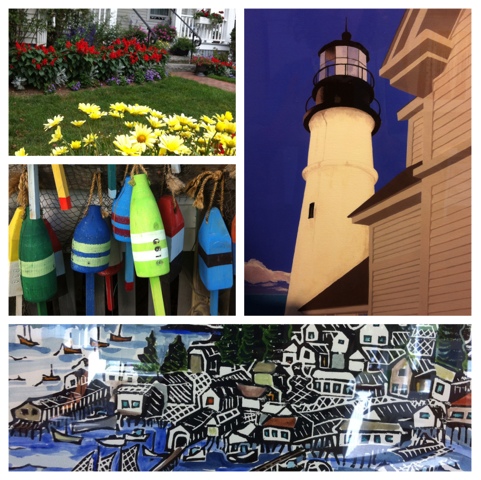
Siasconset on Nantucket

Siasconset is a post office-market-coffee shop village that has the distinction of being situated the furthest out into the Atlantic Ocean.  The houses along its bluff high east bank had the modest beginning as one room fishing shacks. Over the years, bedrooms were added to one side of the house and a porch cum kitchen to the other. 

A dear friend, who is also a HBS beginning-of-the-semester widow, suggested this weekday retreat. A 90 minute drive and 90 minute ferry ride later, found us on this island that we'd only explored when anchoring in Nantucket harbor on Blue Chip. The first day's chill made settling in guilt free. The next day's wind was an excuse to lounge and read. 

By day three, with perfect weather, it was time to explore. Bicycling from one end of the island to the other, walking the cliff past homes of all description and more roses on trellises than one could possibly imagine, neatly trimmed hedgerows and windswept beach grasses combine to perfection.  We ignored the "must visits" and instead  chose our instincts. We found Bartlett's Farm and then there was Millie's in Madaket, with Baja inspired food worth driving from Boston for. (More modest Madaket offers endless beaches and may just be next on our list.) 


We spent the last day in Nantucket Town, an entire 8-miles away. The galleries are enticing and cobble stone streets with whaling era shops enchanting. But neither of us are shoppers, even for these highly curated selections. When I found the West Elm orbs, which were now a decimal point more expensive for having added a felt spot to the base, I decided the offerings were a little to rich for bargain hunting me.

The freedom to plan little, eat sparingly and never have to consider the time was restorative and truly priceless. All in, this was the perfect retreat and the magic of a girls only time away. We'd consider brining the boys another time, but only if they play their cards right.  


Wednesday, September 18, 2013

Frisco Colorado - how high are we?

It's that time of year. Summer is coming to a rapid end and the school semester is beginning. What perfect timing over Labor Day weekend  to get a quick preview of the autumnal weather to come. 


Frisco is home to one of the six McKinsey couples we see every year. After getting accustomed to being 9,000 feet above sea level, we tried Breckinridge, with it's double chairlifts to bring us 12,000 feet up for amazing dining. An afternoon in Vale was a delight. Bicycles, lots of folks with dogs, Oakley sunglasses,  and shorts with polar fleece tops was the rule at the farmers market. There were also lots of folks on crutches healing up before the next season. (There is a reason these two boaters opt for flat water instead of flying down the slopes.)

We had a terrific time. We got some tips from the Frisbee Golf tournament folks, visited the Breck art fair, spent an afternoon on ATV's and managed to pick up some terrific new outerwear. (This area KNOWS outdoor gear in a way two city slickers never will.) Fly fishing could be found wherever there was a stream worth standing in. And the scenery? There aren't words. Thanks Gordon and Mary!


Friday, August 30, 2013

OPB in Maine

There isn't much we look forward to more than boating in Maine. Varying from crayon starter-box bright landscapes to the illusive fog filtered colors that are both equally reflective of what it means to be "down east" in Maine, the views know no equal. Usually we encourage "crew" to join us in August as we dodge a labyrinth of lobster pots. 

Our friends are happy to have Blue Chip as their OPB (Other's People Boat) and we are happy to have them. But this year, Blue Chip in spending the summer in Maryland, getting her ten year "nip and tuck" by the team that built her. So, we were resigned to no Maine this year. 


Enter Abracci. Her 166 feet cut through the water, dodging obstacles with amazing agility. Paul and Judy were incredibly relaxed and gracious hosts, as only Texans can be. The crew of nine pampered the eight of us as we cruised from Camden to Pulpit Harbour, Booth Bay and Bath.  


Steve and I now have a sense of what it's like to be onboard an OPB.  We must agree with our crew these last ten years, having an OPB isn't bad - although even with the "nip and tuck" - our Blue Chip can't offer the experience of Abbraci!
 

Monday, August 26, 2013

Boston - We're back!

Boston may be a city with a rich history, but at its heart, its a sports town. For Steve, who was born here, loyalty to Boston teams may simply be part of his DNA. For me, the New Yorker, it may be in the water. (Hey, MIT and Harvard collaborate regularly and this is the US center for bio-med, so anything's possible!)  We've been home for a month, and besides unpacking and going thought the mail that's accumulated over the last 7 months, we've been lending our support to Boston's athletes. 

Up first - we hadn't gotten over jet lag, but we're there July 20 and the 21st, to support the Red Sox as they took on the "Evil Empire". This ball was wizzing right for my face. The fan next to me caught it with his cheeck and saving me from a definite black eye. 


Next was the Boston Arts weekend, with midnight concerts and Baroque music brunches.  Karen went to visit family in NYC, followed by a weekend of guests. What to do to recuperate? A double header - Patriots and Red Sox. 


Friday August 16, the Patriots took on and beat the Tampa Bay in pre season. Must say the boys looked good. Next two days we were back in Fenway for more Red Sox - Yankees, with mixed results. The new neighbors downstairs have Celtics tickets and we've got Bruin connections - so yup - were back in Boston!   Hmmm - maybe we need to take another trip for some R&R!

Wednesday, July 17, 2013

Madrid & Toledo - what a difference 30 minutes makes

Arriving in Madrid a few days ago, was a shock to the system. After weeks of "charming", we were confronted with drama. Madrid is spectacular - with the urban energy that rocks you. Were we back in New York? Had we been rerouted to London or  Paris?


The buildings are dramatic in scale and history. The boulevards are broad, with tree shaded green meridians. The traffic hectic, with taxis that must be preparing for the Indy 500. The parks and squares are large, prevalent and necessary in a city where summer's normal is hot!


Madrid is museums and they are incredible! Ancient, medieval, modern, contemporary or ham yes HAM. This is a country obsessed with jamon. Even Steve had to take a look at Museo del Jamon, a popular after work gathering point. Karen found an incredible likeness in the famous flamenco performer, SeƱora Carina. 


Then there was Toledo. A mere thirty minutes by train, through beautiful farmland, and you arrive at a truly medieval city. Moor, Jewish and Spanish neighborhoods intertwine with narrow streets, many passable only by scooter. But tall stone buildings combined with narrow cobbled streets keep the temperature cool and the wandering challenging. It's a beautiful retreat from Madrid and worth coming back to. 

A week of the "diet gazpacho" means the pants once again fit, so it's time to end this 5-week adventure and return home - just in time for the Red Sox vs Yankee face off at Fenway that begins on the 19th. Hey - life moves on!


Monday, July 15, 2013

Seville - perfectly bejeweled

Poets, authors, artist and composers have long espoused the love they have for Seville. There is something glorious about the combination of Moorish and Christian Spain that creates magic. 


Historical buildings, from as early as the 8th century, are lavishly embellished with decorative Moorish arches, elaborately carved painted and gilded ceilings of wood or plaster and walls covered with azulejos glazed ceramic tiles that are reminiscent of those found in Morocco. The result is jewelbox homes with fountain centered courtyards and carefully planned gardens dotted with orange trees. 

The Christian conquest in the late 13th century kept the Arabic structures and simply incorporated them within their gothic architecture. Therefore, Seville's monumental cathedral's core is the earlier built masque. The all  important bell tower (La Giraldi) is the 10th century minaret.


The final cathedral is an incredible mix of architecural styles, from Moorish to Rococo, that evolved over centuries. A knave's pure silver alter is stunning. The interior tomb of Chistopher Columbus was a surprise.  (He wasn't always the most popular guy at court, but gained favor by ultimately opening up the New World, and therefore Seville and its port on the Guadalquivir  to incredible commercial growth.) 


The whitewashed and colorfully decorated labyrinth of Santa Cruz is the old Jewish quarter, ironically located alongside these religious structures with thier large public squares. The Jews were generally not embraced by the Moors and many left Seville.  They returned with Christian rule, which turned out to be a BIG mistake, even well before the Inquisition. Thousands died and although none of the old synagogues remain, the Santa Cruz quarter lives on with a museum that tells the awkward relationship that Spain has had with this population over hundreds of years.

Seville is all about life, energy, bull fighting, Flamenco and cafes which stay open late at night with children still running around outside close to midnight. It's an easy going, friendly local - in fact we ran into a branch of the Useppa Miller clan - Kathy and Scott - who were bringing their daughter to a week of camp in Spain, while they "waited" for her in Portugal. Now THERE'S an idea!

Sunday, July 14, 2013

Andalusia - think Clint Eastwood

If you're from northern Europe, Andalusia is all about the beaches of Costa del Sol and the luxury marinas of Marbella. Americans are more likely to have vicariously experienced this area of southern Spain from fabled western movies, including those of a young Clint Eastwood. This area is the most diverse in all of Spain, but it is the history of the bandido and the Moor's Peublos Blancos that capture the imagination. 


We were very fortunate to have stayed at the home of Judy and Arthur Walsh, a generous globe trotting  English couple we met in Burma last year.  Although our list of things to do was long, as we perched high in the hills, with amazing views, garden and pool, rest often won over exploring. 


Unmistakable in this area are the striking hilltop positioned Pueblos Blancos.  Many were first established by the Romans before the time of Christ. The Moors, who took over much of Spain in the 8th century and held onto it until the 15th, expanded these still agriculturally based towns, whitewashing them to deflect the sun. 

Ronda's is known for its dramatic gorge connecting ancient Roman bridge.  It is also Spain's spiritual home of bullfighting and consequently packed with tourists. Many Spaniards making the pilgrimage here to the Corrida Goyesca. The more modest, picturesque and atmosphere filled towns were the nearby Gaucin and Casares, named for Ceasar. Both are dramatic cliffhanging examples that suddenly appear as you drive through the southern sierras. 


Bandido's were another reason for the survival of the Peublos Blancos. Political unrest has long been part of the Spanish ethos. Bandidos spanned the continuum of bandit to Robin Hood and were the subject of romantics well into the early 1900's. The name, Esteban Kaufman, can still cause hearts to flutter or blood to run cold. 

Thursday, July 11, 2013

Siesta? Por supuesto! Merci.

When planning our few days in Barcelona, we were perplexed and frustrated that the tradition of siesta still exists. The closing of most shops between 1 and 4 was not conducive to our squeezing in all the activities we'd lined up. Then we went out for the day and all became clear. 

The easiest way to understand the appeal of tapas small bites and the delight of finding one of the many shaded squares to take a rest in the afternoon, is to observe the color of the sky. Around 11, the bright blue of the morning has turned to white and it remains that way until after 5. There is something about this phenomena that is completely enervating. Streets catering to tourists remain open, but one block in any direction will find shops, bakeries, fish, cheese and ham stores tightly shuttered. We try to ignore the heat, but actually find that giving in makes for a more pleasant experience. We've certainly been to hotter and more humid places, and find ourselves wondering why they don't close down like Spain during the hottest part of the day, and then reopen until 7 or 8 at night?


Barcelona is a delightful walkable city. Installed with the 1992 Olympics, the southern coast boasts a 7kilometer (5 mile) beach, complete with acres of sand, cabanas and chairs to rent. Walk past the marina's pleasure boats and delightful fish restaurants of the city's old fishing village, cross a main road under the watchful eye of Christopher Columbus, and you've entered the beginning of the city proper. We can't think of another European city that can offer endless beach, culture, history and nightlife all within such a short walking distance. 


Few buildings are over 5 stories and most have beautiful facades of the early 1900's Modernists or even earlier times. Broad boulevards and fountains alternate with the narrow twisted turning streets of the gothic and rennaisance neighborhoods. Want to go back even further? Look for structures built atop Roman ruins and aqueducts near the gothic Barcelona's Cathedral and its bell tower 


Markets reflect Barcelona's serious love a fresh food and their proximity to the sea. These covered labyrinths of gastronomy overflow with vegetables, beautiful apricots, hams, cheeses,  olives, fish and seafood of every description - it's all there for the taking. Some of the meat options are "interesting". (Pig trotters I get, but the goat heads allude me.) Cups of fresh fruit and iced fruit on a stick never looked so appealing. Can't wait to get home? Sit at one of the many tapas bars inside of the market. The delicious food that gets turned out of these minute stalls, negate any claims for the need of a larger kitchen.


Modernist architecture and art is specific to Barcelona 's unique personality. Think of Gaudi and Miro's work at the turn of the 1900's.  It's the time of the impressionist and Frank Loyd Wright. The Modernists painters have been to France, but Miro returns here with Picasso and Calder and they come to a very different conclusion about art. Their's is highly fanciful, brightly colored, the thing of dreams.  Gaudi, and his architectural peers apply ceramics and bright graphic designs to building facades. Inspired by nature an God, Gaudi builds homes with all curved walls and finally devotes his life to creating the Sagrada Familia cathedral.  This ongoing effort is slated to be completed in 2026, the 100th anniversary of his death. 


Oh and besides pronouncing all "S" sounds with a lisp - the use of  "Merci" for thank you is NOT a language mistake. Signage here is in two languages - Spanish and Catalonian. Referendums for independence from mother Spain have recently received about a 50% vote and continues to be a hotly debated topic. Catalonian flags are a common sight. People native to this city are more likely to speak Catalonian to each other than Spanish.  This perplexing mix of Spanish and French, which is essentially Catalonian, results in "merci" rather then "gracias". Throw in the local paella which is pasta instead of rice based and an obsession with ham (legs of jamon come home at the cost of $130 or more) and you can question what you thought you knew about Spain. 


Monday, July 8, 2013

We made it!

"Pictograms" became a regular part of the morning briefing as we all attempt to translate bike-guide-speak. Part of it may be the accents of our ever so charming Spanish, Italian, Irish and South African guides, however I'm convinced the bigger issue is a fine line between encouraging one to increase their ability and not fully underestimating the condition of some of our joints. 
The reality, the guides couldn't be better, both in terms of encouragement AND willingness to hoist bikes on top of vans when the going was simply too rough. We continued to travel the west coast of Mallorca, each day traversing the mountain range down to the coast. Above you see us at Port Soller, which has a beautifully arched harbor, with old wooden trolley cars,  a busy beach and more tourists than we've seen,  but still charming. 

Back up in the hills, we stay in Deia at La Residencia. The hotel feels like a series of stone homes, carved into the mountain side. Finally there is a few hours of rest for the weary, but the idyllic hilltop of Deia calls. Once the home of Anais Nin, it later became a retreat for musicians and artists after the first world war. The church atop the hill closes the loop for the ceramic stations of the cross  imbedded on walls and the sides of homes that line the town's only real road. (No I didn't draw this, but maybe someday.)


Each day has its own unique WOW moment. It might be a particularly spectacular view, access to a private art collection, visiting a winery or cocktails at the home of one of our hotel's architect. More than once, it has been the ride itself. Accomplishing an uphill climb you couldn't have done a few days before is a thrill. (The knees do get better and some cadence coaching from a Mallorcan Olympic  multiple time medal winner certianly helps.) The views down to the sea and through the mountains, as we learn to handle the speed that comes with a 8 mile switchback descent, is as unforgettable as anything else we experience. We continue to Valdemossa, Banyalbufar, Estellences and Port d'Andratx. 

Steve's biggest WOW may have been the 4 hour transfer from Port d'Andratx back to Palma on a 137 foot ketch. As we round Mallorca's southern tip, we are blown away by the explosion of development. Fully developed beach resorts appear, with all the tall buildings needed to accomodate the island's 10-million annual guests. 

However, our boat glides by to the eastern shore, as we duck civilization for just a bit longer. The Cap Roca Hotel is a fortress that was designed to protect Palma's port. Hidden from the water's view, you land on the beach and make your way up to something never experienced before. Besides its physical attributes, it acts as a fortress from the world and it's worries. The simple and beautifully appointed space has Morrococan and Arabic overtones. The infinity pool overlooks the sea. The optional outside canopied barley bed is a tempting alternative but it's the continental breakfast that arrives in multiple baskets to be eaten on our patio that really impresses. 
There's a last push to ride to Porreres and Algaida before going into Palma for the evening. We all do our best to stay awake at our last dinner at Puro Beach. 

The last morning, we take a quick drive into Palma.  The Gothic cathedral impresess. It is one of the few that is actually built on the coast, rather than in the middle of the city.  The result is that it's full facade can be seen, which adds to its grandeur.  Antonio Gaudi, the famous Spanish Catalan Modernist from the late 1800s, helped to redesign its open airy interior. 

Mallorca has proven to be an amazing place. We would welcome the opportunity to return. Anyone interested?


Tuesday, July 2, 2013

Bike Mallorca

After biking last year in Burma, we thought Mallorca with a group of 32 interested in biking, adventure, food and wine? A piece of cake!

Note to self - check topography BEFORE signing up for cycling trip. But I'm getting ahead of myself. 

Mallorca, a Spanish island located east of Valencia, is picture perfect beautiful. If you love dramatic stone cragged mountains, mixed with a multitude of small farms, buildings of peach colored stone, groves of olives and orange, vineyards, the occassional meandering sheep or horned goats and Med beautiful beaches without the crowds - then this is a place you want to visit. 

On our first day, we peddle from northern Pollenca's cobble stone square and old world charm to make our way to coastal Alcuidia, the island's only remaining medieval walled city. We then pass through Port de Pollenca and some of us were ready to stop right there to enjoy the endless beaches.  (We ARE on vacation.)

By the way, did you note the word "mountains" above? We leave the coastal region for a "long gentle incline." (This is bike guide speak for the four kilometer climb, with switchbacks and no guardrails.) The Serra Tramuntana range runs 55 miles parallel to the east coast and rises over 1,300 feet. Was it worth it?   See for yourself. We think the view from Miador des Colomers was simply amazing. 


The blue waters in the distance is the coastal areas of Alcuidia  and Port de Pollenca. (Yes, please be impressed.) Once the top is reached, you find amazing views. Add in the beguiling guitar playing and love padlocks, reminiscent of those found on Paris' Ponte des Erte bridge, and you begin to get the feel of this place. 


Mallorca is a difficult to define blend of raw and rough with tender and warm. The colors range from the sun bleached grey green of olive trees and parched terra cotta land to deep pine, rich sienna and riots of Bougainvillea's deep magenta, punctuated with the inevitable basket of orange and yellow citrus.  Pancake flat to steep mountains are somehow no surprise here. There is a sense of calm and then suddenly you find your heart is racing. You thought you knew yourself and then.....