Showing posts with label Rhine. Show all posts

Thursday, July 21, 2016

Bern - Bicycling Anyone?


Bern is the Swiss city of Bears
As reflected in its Canton's flag, it is Switzerland's capital with a population of 140,000, or 360,000 for the larger incorporated area, and Switzerland's fourth most populous city. (There are 26 Cantons in Switzerland, each with its own flag that flies along with the Swiss flag. More on that later.) 
It is also the city where Einstein lived in a 2nd floor apartment above one of the main cobblestone streets in the old town center between 1903 and 1905, when he first developed his theory of relativity, while working as a patent examiner. Oh, and by the way the small cafe downstairs isn't bad either. 

Like most European cities with Medieval roots, Bern Minster is the cities major Cathedral. Begun in 1421, it evolved into a Gothic style, was completed in 1893 and has towers of 330 feet. It is now a Swiss Reformed Cathedral and the tallest cathedral in Switzerland. It is well known for the detailed relief of The Lad Judgement above the main door. Michael the Archangel holds his sword, with the wicked naked on the left and the righteous clothed in white on the right.   
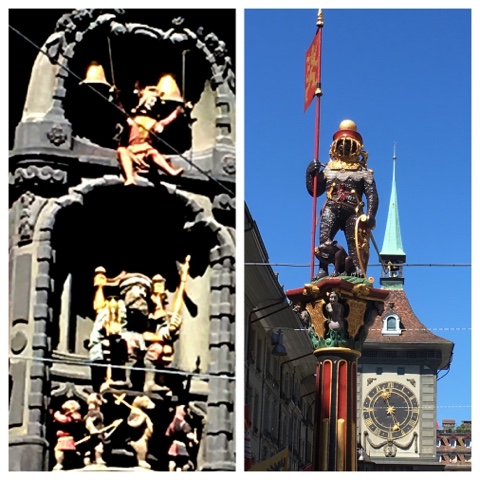
The Medieval Zytglogge clock tower at the end of Kramgasse is from 1220 and originally defined the edge of the city. Below the clock face is an astronomical clock with moving pieces that delight when it  chimes every 15 minutes. For those with a burning curiosity, you can climb the steps to go inside the tower and see its workings. As is often the case, on the hour and noontime are  the really big shows with moving parts that reinforce a story of time passing and personal responsibility. 
The old town streets are charming and a UNESCO Heritage site since 1983. They are particularly wide and cobblestoned, punctuated with statuary fountains that boast flowers at this time of year. These bears, soldiers and notable personalities are seen hovering above stone fountains with copper pipes that jut out delivering the coldest, clearest  pure water - from the Aare River, a major contributory, on its way to the Rhine.

Karen samples the fountain's water near the clock tower and agrees that we should all get out our water bottles! 
When we were there on Juky 20th,  the city was ready to welcome a couple of hundred two wheeled international athletes. Suddenly at 1:30, everyone politely stepped away and cleared a path, chearing as they peddled, streaking through from Bern to Finhaut-Emosson (Switzerland), a mere 184.5KM distance. It was a short run for the participants - unforgettable for us and took no longer than 36 seconds - we know because Steve taped the whole thing. 
Naturally you can purchase a Tour de France "fan kit", complete with hat, shirt, water bottle and backpack, as modeled by our friends Suzy and Vic. Even without the colorful fan kit, an unforgettable experience!

Bern is ranked one of the top ten cities in the world for quality of life. That pretty much says it all. 


Strasbourg - Still Special

There is something unique immediately felt in Strasbourg, one of Europe's most attractive cities. Due to its rich architectural heritage, the entire town center, "Grande Ile," has been listed as a UNESCO World Heritage site since 1988 and the first to be designated as such in France.
The Alsace German French background is reflected in the homes. German timberframe homes were built between the 16th and 17th centuries. Each timber was numbered to allow them to be deconstructed, moved and rebuilt. The later change to the  stone French style traded off mobility to leesen chance of fire. 
Stork motifs can be found everywhere as can large white and black storks who tend to live atop homes and in trees of a particular neighborhood where they are fed by the community. Legend has it that if a sugar cube is placed on a windowsill a baby will soon appear. With a population of 480 thousand (52 thousand if which are medical and Pharma students), it would seem that the storks have been kept quite busy. 
The cuisine options are many and all delicious. You can easily guess Steve was drawn to the menu on the left and Karen to the right, but there are no bad food choices here. 
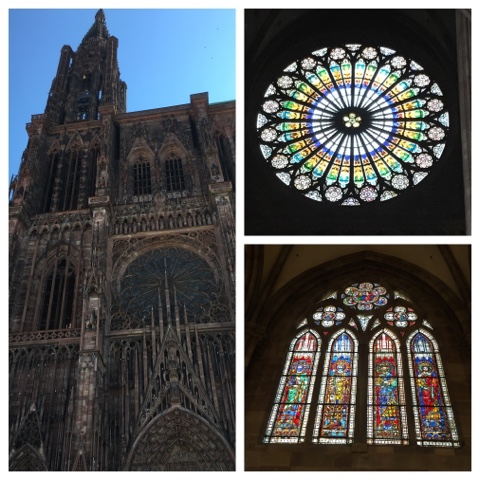
Notre Dame Cathedral of Strasbourg  was built between the 13th and 15th centuries in the Gothic style. The exceptional original stained glass was removed during the World War for safe keeping and the reinserted, including the spectacular rose window that is similar to the one found in Paris. The pink sandstone structure requires a team of 50 to continuously repair this delicate structure. 
The astronomical clock has not failed in hundreds of years. An example of exceptional engineering, it tracks time and days, making allowances for months of various lengths and leap year. About midway up, when the clock strikes reflecting another fifteen minutes has passed, a figure of either a baby, youth, soldier or elderly man passes by, indicating life's 4 phases. At 12:30 is when the real action happens, complete with all 12 apostles cross in front of Christ. The cathedral closes from 11:30 to 12:35, so if you want to see how a click originally installed in the mid 1300's and last updated in the mid 1800's performs this remarkable feat, then I suggest you get there early! 


Romantic Rhine - Castles Galore and Picturesque Heidelberg (repost with spell correct....grrrr!)

The Middle Rhine, from Bonn to Bingen, flows through the Rhine Gorge, which averages 430 feet from the waterline to the top of the rocks.

With no less than 40 castles and fortresses between Koblenz and Bingen, it's easy to understand why this stretch is called the Romantic Rhine and is a UNESCO Heritage Site.
Heidelberg was a particular treat. In 1944 the US dropped leaflets promising not bomb the city and their plans to live there, which they did until the US army base closed in 2013. Today people from dozens of nations live in this city of 154,000.

Heidelberg Castle's construction began in 1294 and continued through the 1700's. Although now much deteriorated, this medieval castle was the country's capital until overtaken by the French 300 years ago when the capital was moved to Mann where a Versailles-like palace was built, reflecting the influence of the French at that time. 

Victor Hugo in 1838 wrote "What times it has been through! Five hundred years long it has been victim to all that has  shaken Europe ....it has always taken up some opposition to the powerful." Still it stands in defiance of time marching on and can't help but remind you of days gone by. 

Today "Heidelberger Schloss" draws close to three million tourists annually. The main building has a unique facade and houses the worlds largest wine cask, which can hold over 58,000 gallons. Perkeo, a court jester and Herculean drinker of wine, is its eternal guardian.   
Views from the castle fortress provide a near birds' eye view of this picturesque city and its multiple bridges across the Rhine-Neckar River. The bridges were destroyed by the Germans in an unsuccessful attempt to slow the Americans from taking Heidelberg in 1945 and where the US army remained on its base until 2013.
MIT's delegation gives Heidelberg a definite thumbs up. 
 
Heidelberg has inspired many including Brahms, Schuman, Turner and Mark Twain writes of Heidelberg in his Trip Abroad - must reading for any traveler. 

Goethe at 75 is quoted as saying after finding his 29 year old love - Here was I loved and beloved - or - "Hier war ich glucklich liebend und gelebt." So, if you happen to be looking for love, maybe Heidelberg is a place to visit.


A Week on the Rhine Begins


If relaxation, while floating down a river with beautiful surroundings, sprinkled with castles and historic places of interest  sounds appealing to you, then look no further than the Rhine. 

The Rhine's exit to the sea is Rotterdam and we joined via tributary from Amsterdam and its 634 miles runs south to north, so we were actually moving up the river to Basel, but all that aside, the Amadeus Silver III, her captain & crew were terrific.  The educational resources on this MIT, Notre Dame, etc sponsored cruise kept us on our toes as we learned about the music, history and geology of the area. 
Going from below sea level in Rotterdam to 800 feet above sea level in Basel required a mere 12 locks. Although we're accustomed to locks, many of these were quite different. Most were a cement wall that moved slowly up after the barge tied up and the lock filled with 10 to 30 or more feet of water - as you see in the picture above.....and below. 
The engineering is incredible!

Cologne was our first stop. This city of one million is the largest on the Rhine. This renowned monument of German Catholicism and Gothic architecture is Germany's most visited landmark and a world Heritage Site. The cornerstone was laid in 1248. The 515 foot towers were not in place until the 1840's, using the original medieval plans found in France, but using modern iron girders. The Cathedral was finally completed in 1880.

During WW II, it suffered 14 hits by arial bombs yet remained standing. By1956 original stained glass was reinserted and structural repairs made. Notably  until 2007 plain glass was found in a 66 foot tall opening. Seen above is Gerhard Richter's design which uses randomly placed, identically sized squares representing every color found in the Cathedral's other stained glass designed over hundreds of years.  "The High Cathedral of Saint Peter" has many fascinating historical and religious attributes that really are worth seeing. 
The day we were in town, the city was getting ready for its annual firework display. People come from far and wide. 
We particularly enjoyed what appeared to be a modern day Pied Piper, with his seemingly endless display of magical bubbles!
In Bonn we shared typical German fare with our Useppa friends, Suzy and Vic Trino as Steve gets his FIRST Schnitzel fix.
We pass the Old City Hall in the historical  square as we make our way back to the barge and attempt to work off at least some of a "healthy" dinner.