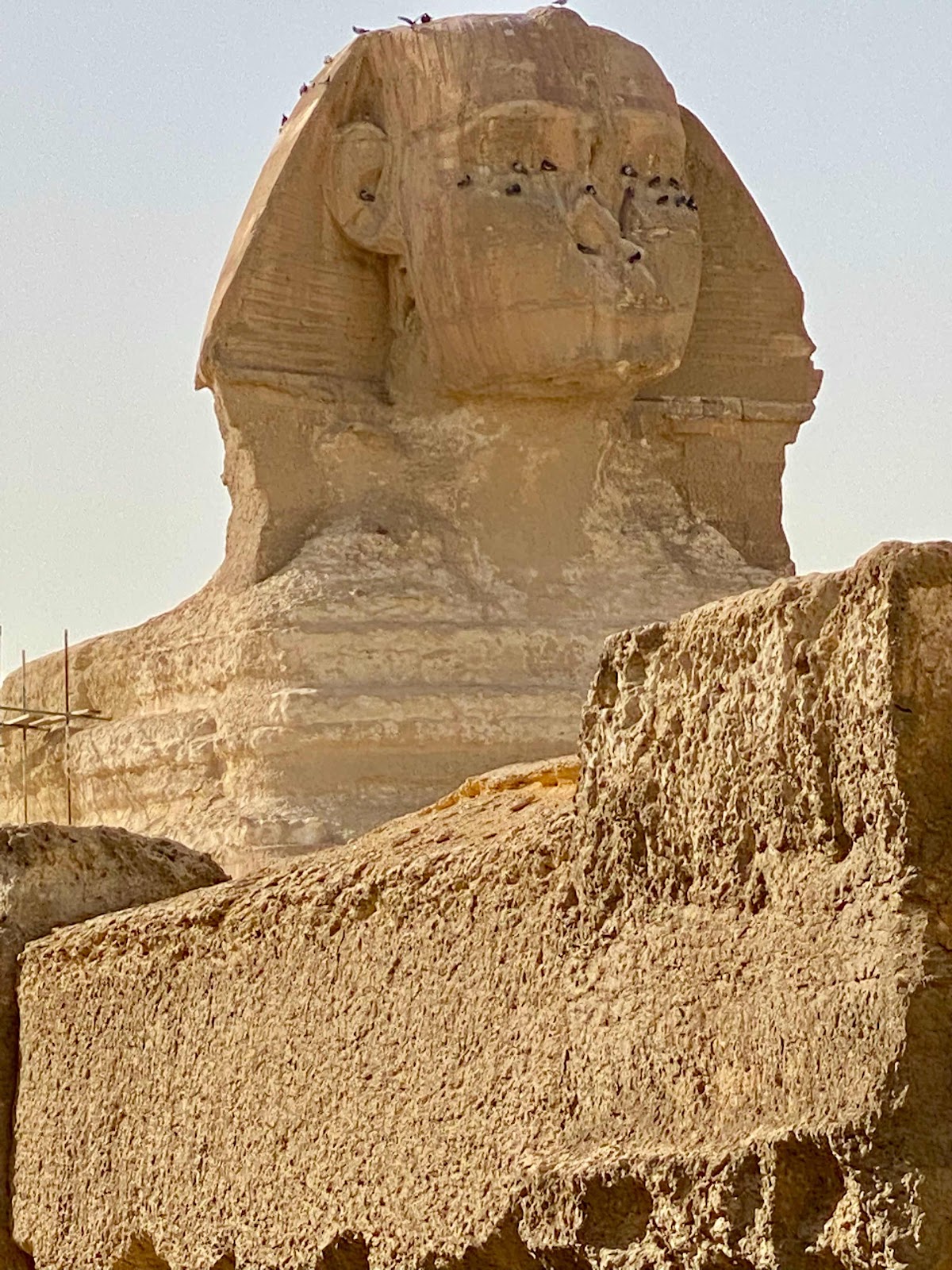
The SPHINX is instantly one of the iconic images that comes to mind when you hear the word EGYPT.
Do you imagine it sitting arbitrarily in the desert with nothing around for miles and maybe near an oasis?
Do you wonder why it came to be and how big is it REALLY? Well let’s get to the bottom of it.
The Sphinx is located in Giza at a funerary site in the same general area as Saqqara. (Extra points for those that remember Saqqara is the location of the Step Pyramid.) Completed in 2500 BC, it is the earliest known sculpture of ancient Egypt. The Sphinx stands guard as you approach the Pyramid of Khafre, one of the three pyramids Giza is best known for. Why is it there? King Khafre and his architect hadn’t planned for this sculpture, but some of the limestone stone delivered hundreds of miles up the Nile from Luxor was too soft to use for the pyramid and so a sculpture was proposed. How much stone you ask? Enough to build a sculpture 66 feet tall and 185 feet long. (Yes, that’s just under 2/3 the size of a football field.) The elongated body with outstretched paws is topped by a royal headdress framed face that is likely King Khafre himself, which for centuries has been missing his royal beard. (You can view a piece of his “missing” Roy,a beard at the British Museum in London.) To mankind's benefit, Egypt’s capital eventually moved south and, with fewer people caring for the funerary site, wind swept in sand, eventually covering the Sphinx up to its neck along with other pyramids on the site. This is the primary reason why they have remained intact until discovered by Auguste Mariette in 1852.
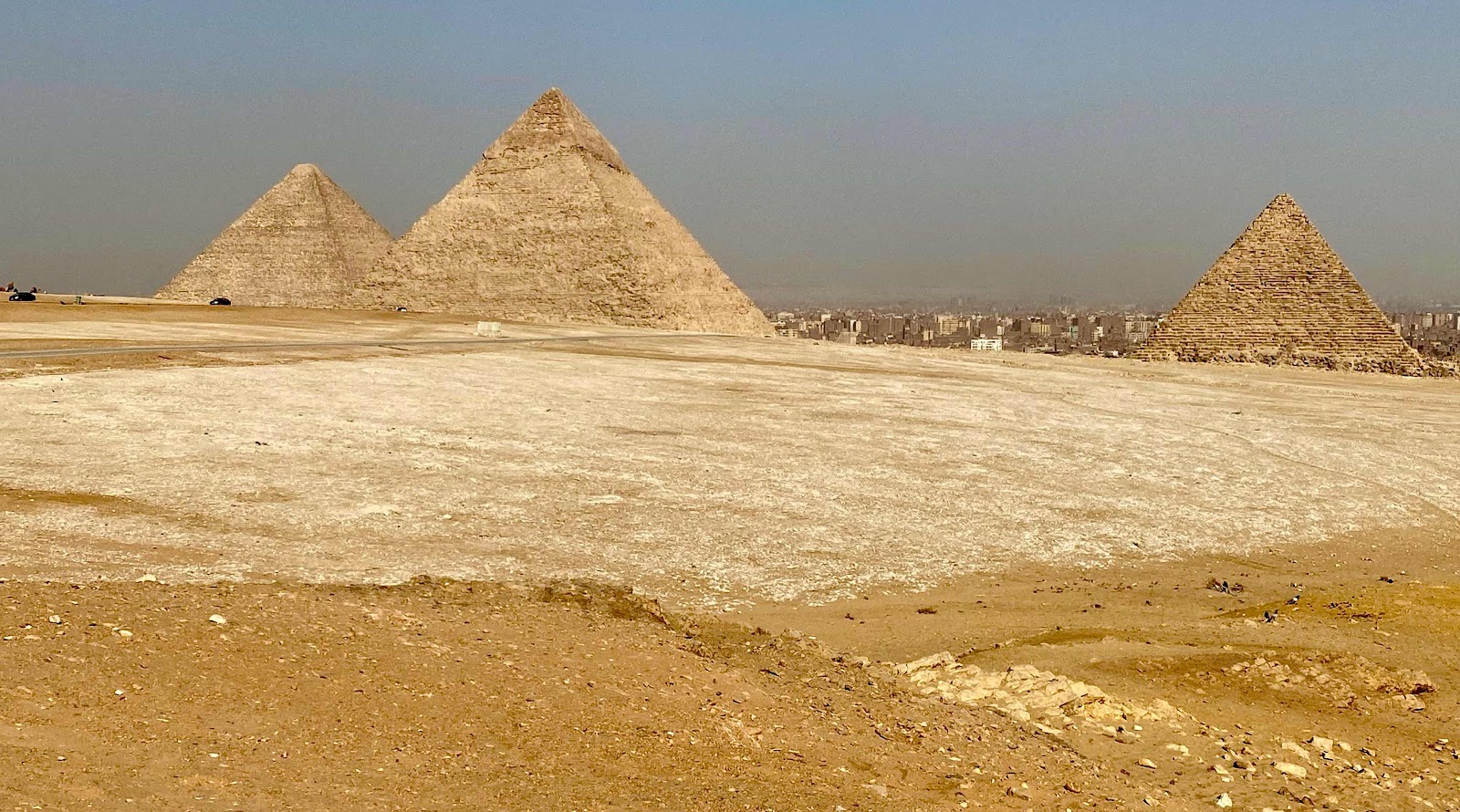
The Giza plateau contains 3 pyramids for three different kings, each worthy of note for different reasons, while all sharing some common attributes.
All three were built at separate times during the lifetime of their respective king for their eventual entombment. Each had accessory pyramids for purposes such as body preparation or, in the case of Menkaure, for each of his three wives. Each took about a decade to build, primarily by thousands of farmers during the 4-months of the Nile’s summer flood season between June and October. Beyond employment, these workers wanted to honor their god kingwhom they relied on for balance and predictability in their world. Stone was brought up via the flooding Nile which rose spreading several miles to the edge of the Giza plateau. The design innovation of these, as compared to the earlier step pyramid, is that although they all began as stacked granite or limestone mastabas, limestone was used to create the smooth finish we associate with Old Kingdom Egyptian pyramids and which can still be seen atop King Khafre’s pyramid.

So you are probably wondering about scale and what some of the general statistics we are talking about here.
King Khula’s pyramid is generally referred to as the Great Pyramid. In the late 1700’s Napoleon’s explorers counted nearly two-and-a-half million blocks, each weighing on average 1.5 to 2 tons. Until the 19th century it’s 450 feet made it the tallest building in the world. The structure’s precision is amazing - the greatest difference in length between the four 756-foot sides is only 2 inches. Really. The construction methods and exact purpose of some of their many interior chambers and shafts are unknown, but this fantastic architectural achievement is indisputable.
 D
DSo what do we recommend? Make your way to Egypt and see for yourself. Over the centuries, both BC and AD, many have broken into and robbed the pyramids. In the 12th century one of Cairo’s sultans attempted to dismantle Menkaure’s pyramid, which at about one quarter of the size of the Great Pyramid is by far the smallest of the three. After eight months the project was abandoned after only achieving the vertical scar seen on the north face. Medieval rulers of Cairo also took and used most of the limestone for their own monuments. In the 1700’s archeologists began removing sand and uncovering these treasures. In the 1800’s hundreds of boats would travel the Nile to see these, and other, treasures as part of the Grand Tour. Today, tens of thousands arrive annually.

With the growth in Cairo and Giza populations, we need not worry about the pyramids or the Sphinx ever again being buried in sand. However, Steve may just bring one home, if he can shrink it down enough to fit into his roll on bag. So come and be wowed by one of the world’s mysteries!